










Home » Lab Equipment Supplies » Laboratory Centrifuge » Laboratory Centrifuge
Laboratory Centrifuge
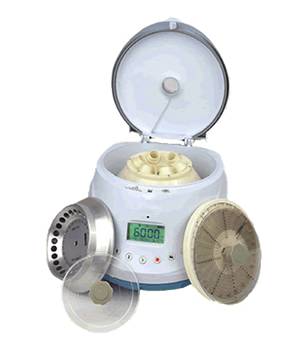
Centrifuge with 3 Interchangeable Rotors
Retail Price: $3,454.44
Your Price: $2,925.00
 Unit: single


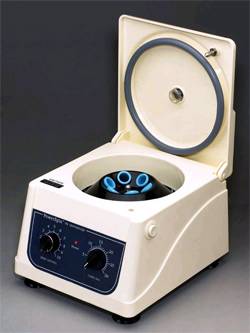
Variable Speed Centrifuge with 6 Place Rotor
Retail Price: $593.09
Your Price: $432.09
Unit: single
Fixed Angle 6 Place Lab Centrifuge
Retail Price: $2,396.19
Your Price: $1,912.65
Unit: single
The accuracy of patient diagnosis is based largely upon the efficiency of the lab. Test results received in medical labs will guide the physician in making better recommendations and even in prescribing prescriptions. Reliable equipment such as the often used laboratory centrifuge is vital to the health of any patient. Poorly run tests, or ruined samples could skew results, a mistake that could very well lead to a misdiagnosis, and as a result, even death. The goal of any hospital, then, is to save lives, not cost them. In order to more confidently trust the results passed along to your physician, it is best to acquire high quality lab equipment. High quality laboratory centrifuges have many features which are critical to their performance. These features should be carefully weighed when selecting the right centrifuge machine for your lab.
The purpose of a laboratory centrifuge is to spin samples in tubes until the substances which compose the mixture settle into layers of varying density. There are three main types of centrifuge: diffusion, isopycnic, and sucrose gradient. Which centrifuge you should invest in will depend upon the materials you need separated. If you need to separate the various cell organelles from the whole, a diffusion centrifuge is just the machine for the job. Diffusion centrifuges are used for cell study and microbiology. By subjecting the samples to repeated filtering and spins, the organelles can be extracted from the whole and more closely examined individually. It is the isopycnic laboratory centrifuges that are required for the extremely high speeds necessary for separating the nucleic acids from a DNA strand. This enables the researcher or technician to study the base pairs in the genetic makeup of the sample. Sucrose gradient enables the technician to remove the coating of protected viruses, or ribosomes. Like diffusion, it is also a means of extracting the individual cell organelles from the rest of the cell. When making your decision in choosing a centrifuge, it is imperative to take into account exactly what functions the centrifuge has, and if you will even need those attributes.
You will need a high quality laboratory centrifuge in order to assure that you are getting accurate results. If the unit over processes the sample or wobbles during use, it can lead to a manifold of problems and require a replacement sample. This would not only pose an inconvenience to hospitals but a waste of time for you, since such a problem could have easily been avoided, with a little knowledge, and touch of common sense. To prevent wobbling when the unit is on, counterweights should be used. These could very well be identical tubes with the same mass. There should also be a safety cut-off that will power down the machine in case an imbalance is detected. A wobbling laboratory centrifuge can cause injuries to the technicians and serious damage to the machine. The inclusion of a timer is also a great idea in order to prevent over processing. These safety mechanisms will ensure the accuracy of the results and the safety of those working in the lab.
For trustworthy results from your laboratory tests, you will need a high quality laboratory centrifuge that is equipped with safety in mind. Procuring the safest, most effective centrifuge machines will lend credence to your lab, and bring ease and peace of mind to your technicians.